
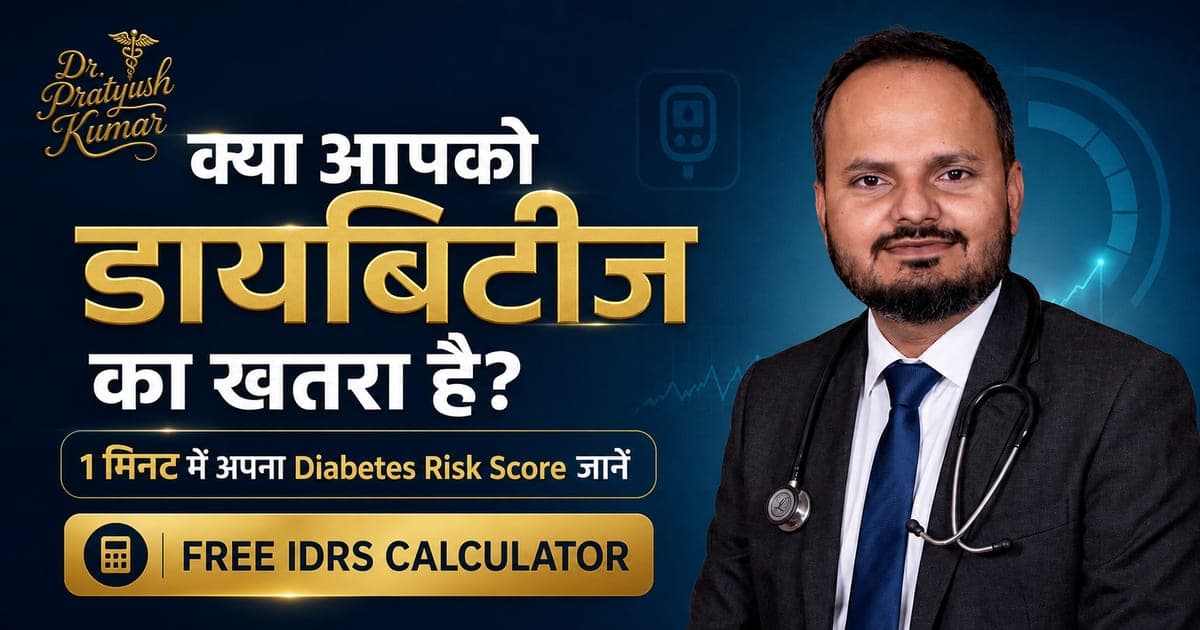
Type 2 diabetes may begin without obvious symptoms. Increasing age, abdominal fat, low activity and diabetes in parents can increase risk.
The Indian Diabetes Risk Score (IDRS) was developed to help screen for undiagnosed type 2 diabetes in Indian adults. It uses four simple factors and does not require a blood report.
Open the English IDRS calculator or browse all health tools.
Free IDRS calculator
Calculate your Diabetes Risk Score
Enter your details below. Your information is not sent or saved.
This is a screening tool, not a diagnosis. A low score does not rule out diabetes, and a high score does not confirm it.
How the score is calculated
The total ranges from 0 to 100.
| Factor | Categories | Points |
|---|---|---|
| Age | Under 35 / 35–49 / 50 or above | 0 / 20 / 30 |
| Waist, men | Under 90 / 90–99.9 / 100 cm or above | 0 / 10 / 20 |
| Waist, women | Under 80 / 80–89.9 / 90 cm or above | 0 / 10 / 20 |
| Activity | Vigorous / moderate / light / sedentary | 0 / 10 / 20 / 30 |
| Diabetes in parents | Neither / one / both | 0 / 10 / 20 |
Measure your waist carefully
Stand comfortably and place a horizontal tape around the waist between the lower rib and upper hip bone. Keep it snug without compressing the skin, and read after a normal breath out. Measuring consistently helps avoid a misleading result.
What your score means
Below 30 indicates lower screening risk, 30–50 moderate risk and 60 or more higher risk. A higher score should prompt discussion of blood tests, rather than an assumption that diabetes is confirmed.
A low score does not exclude diabetes. Excessive thirst or urination, unexplained weight loss, blurred vision, slow wound healing, recurrent infections or marked fatigue require assessment regardless of the score.
Why waist and family history matter
Abdominal fat can carry metabolic risk even when total weight or BMI seems modest. IDRS therefore uses sex-specific waist thresholds. Diabetes in a parent increases inherited risk, but genes do not determine the outcome alone. Activity, weight, food quality, sleep, tobacco avoidance, BP and lipids all matter.
A score is different from a diagnostic test
IDRS estimates screening risk. Fasting plasma glucose, HbA1c or an oral glucose tolerance test helps determine whether diabetes or prediabetes is present.
This calculator does not assess treatment in someone with known diabetes, diagnose type 1 diabetes, replace gestational-diabetes testing or guide care after an already high glucose result.
Next steps
Bring the result and any recent glucose reports to a diabetes consultation. Agree on suitable laboratory tests and a realistic prevention plan.
Scientific sources
- Original IDRS study: Mohan and colleagues
- ICMR–INDIAB evaluation of MDRF-IDRS
- RSSDI practice recommendations
This article is for health education and does not replace an individual medical consultation. Symptoms, test results, medicines, and treatment decisions should be discussed with a qualified clinician.
Seek urgent medical care for severe breathing difficulty, chest pain, confusion, fainting, uncontrolled bleeding, severe dehydration, or rapidly worsening symptoms.